


















Why buy a dive torch?
Whether you are a recreational underwater explorer (0-30m), deep diver (30m+), amateur, or professional, a key requirement is a dive torch to light your way underwater. Dive torches are also useful when needing to read non-illuminated devices while underwater, such as a compass, and air and depth gauges. The deeper you dive, the darker it becomes, therefore it is important to choose a specific dive torch for your needs. Dive torches can also be used as signalling dev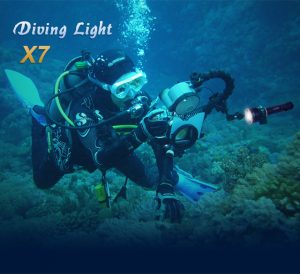 ices when diving with companions.
dive torches available from LED torch shop,
Things to consider when buying a dive torch:
Lumens: A torch with higher lumens emits more light. Many dive torches are now available with adjustable lumen settings. It is a big plus to have a higher lumen output while you are under water because the light is not going to travel as far.
Light beam: A narrow beam is brighter and focuses on a smaller particular area, whereas a broad beam assists to light up a larger area. Depending on what diving you are going to do you might want a mix between both or a specific one.
Brightness: Related to the lumens and the beam. Brighter isn’t always better, as suspended particles in the water can reflect bright light back to you.
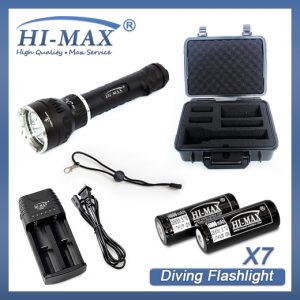
Battery Life: While rechargeable batteries are better for the environment, they lose life-length with use, reducing the run time, therefore making them most suited to shorter periods of use. However, non-rechargeable batteries will last a lot longer, therefore if you wish to dive for long hours, a non-rechargeable battery is recommended. Dive torches can burn through batteries quickly. A torch with adjustable lumen settings can prolong the battery run time.
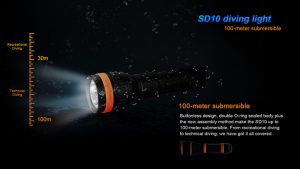
Depth: Consider choosing a torch compatible with the depth of your diving, and ensure that it is “water-tight” (rather than “waterproof”) and “pressure-proof” to prevent breakage and/or malfunction.
Time of dive: Daytime diving will usually only require a narrow beam torch. Nighttime diving can require a primary broad beam torch to navigate more easily, and also a secondary torch as back-up if required.
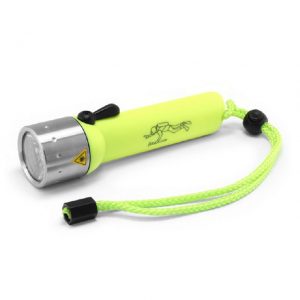 Weight, size, handle: These factors should be considered, depending on whether you will be holding, strapping, or mounting your torch. Handles, ‘pistol grip’ or ‘lantern grip’ are available, and it is personal preference which handle you choose as to the type and length of your dive.
Bulb type: Halogen and tungsten are cheaper, but not as bright and burn through batteries. HIDs and LEDs are more expensive, but are more efficient.